

For tight-fitting respiratory protective equipment (RPE) to provide the intended protection, it needs to fit the individual wearer correctly. Face fit testing checks whether a specific make, model and size of facepiece achieves an adequate seal against that person's face.
In the UK, HSE guidance INDG479 sets out good practice for fit testing. The requirement is also supported by Approved Codes of Practice associated with regulations including COSHH, the Control of Asbestos Regulations, Control of Lead at Work Regulations and Confined Spaces Regulations.
Fit testing should be carried out by a competent person and repeated where changes to the RPE or wearer could affect the fit.
What types of face fit testing are available?
There are two main approaches: qualitative and quantitative fit testing.
Qualitative fit testing (QLFT) uses a bitter or sweet test agent to provide a pass or fail result. If the wearer can taste the substance while completing the test exercises, the facepiece has failed. It can be used with disposable and reusable half masks but not full-face masks.
Quantitative fit testing (QNFT) produces a numerical fit factor, providing an objective measurement of fit. Two principal technologies are available:
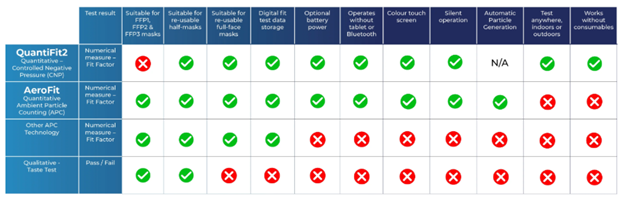
Ambient Particle Counting (APC/CNC) compares the concentration of particles outside and inside the respirator. It can be used with disposable filtering facepieces, reusable half masks and full-face masks when the appropriate equipment and protocols are used.
Controlled Negative Pressure (CNP) measures leakage directly by creating a controlled negative pressure inside a temporarily sealed facepiece. It can be used with compatible reusable half and full-face masks but cannot test disposable filtering facepieces.
Both are recognised quantitative approaches. The right choice depends primarily on the RPE being tested and where testing needs to take place.
Choosing between APC and CNP
Organisations using disposable FFP respirators will require an APC/CNC system. CNP can be particularly useful for reusable RPE and field testing because it does not rely on ambient particle concentrations or require particle-generating consumables.
For organisations managing a mixed RPE fleet, access to both technologies provides greater flexibility.
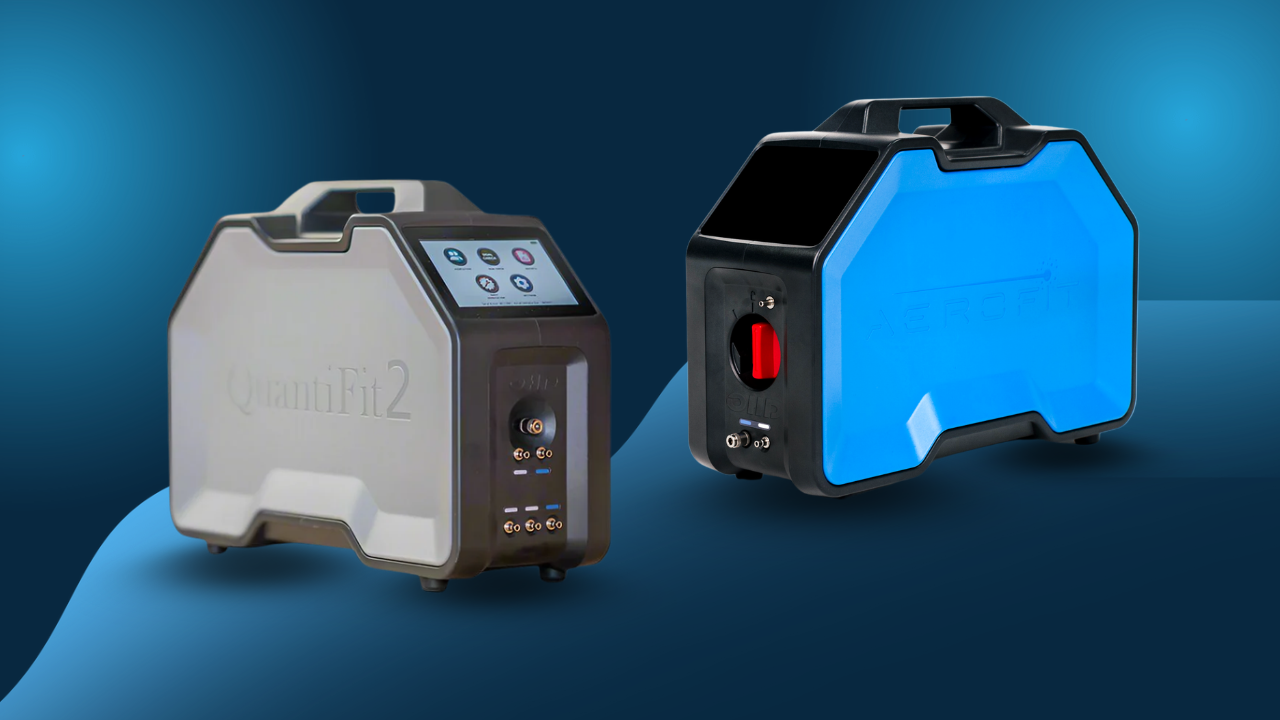
This is where OHD's fit-testing range differs. OHD states that it is the only manufacturer offering both quantitative technologies, with QuantiFit2 using CNP and AeroFit using APC/CNC.
OHD fit-testing technology is used across applications ranging from emergency services, military and occupational hygiene to healthcare, mining and motorsport, and is available exclusively through Shawcity in the UK.
OHD fit-testing systems and current trade-in offer
Shawcity is currently offering £500 off selected OHD fit testers until 30 June 2027, with the first annual service and calibration included free of charge.
Upgrade to OHD and save up to £1,260 + VAT.
|
System |
Technology & application |
Part-exchange offer |
|
QuantiFit2 |
CNP quantitative fit testing |
Was £8,400, now £7,900 + VAT. First annual service & calibration FREE – worth £465 + VAT. Total saving: £965 + VAT. |
|
AeroFit |
APC/CNC – equivalent functionality to TSI PortaCount 8048 |
Was £9,542, now £9,042 + VAT. First annual service & calibration FREE – worth £760 + VAT. Total saving: £1,260 + VAT. |
|
AeroFit Lite* |
APC/CNC – equivalent functionality to TSI PortaCount 8040 |
POA. First annual service & calibration FREE – worth £760 + VAT. Total saving: £760 + VAT + part-exchange saving where applicable. |
You don't need to be an existing OHD customer to take advantage of the offer. Shawcity will consider fit testing equipment from any manufacturer for part-exchange. Contact our team for full eligibility and offer details.
Which fit tester is right for you?
The starting point should always be the RPE your workforce uses.
If you need to test disposable FFPs alongside reusable masks, an APC/CNC system such as AeroFit may be the appropriate option. If your programme primarily covers reusable half or full-face masks, particularly where testing takes place in different environments, CNP with QuantiFit2 may be more suitable.
For organisations using a mixture of RPE, having access to both technologies allows the test method to be selected around the respirator and application rather than the limitations of a single technology.
To discuss your face fit-testing requirements, compare OHD systems or find out whether your existing fit tester qualifies for the £500 part-exchange offer, contact Shawcity for further information.
Customer Testimonial:
"The QuantiFit2 was a joy to work with. After scanning the quick start QR code it was simple to set up and start using. I like that you don’t have to mess around with alcohol.
Everyone who has used it has said how much easier it is to use than the Portacount. Great product."
- UK Based Military Customer





 01367 899553
 info@shawcity.co.uk