

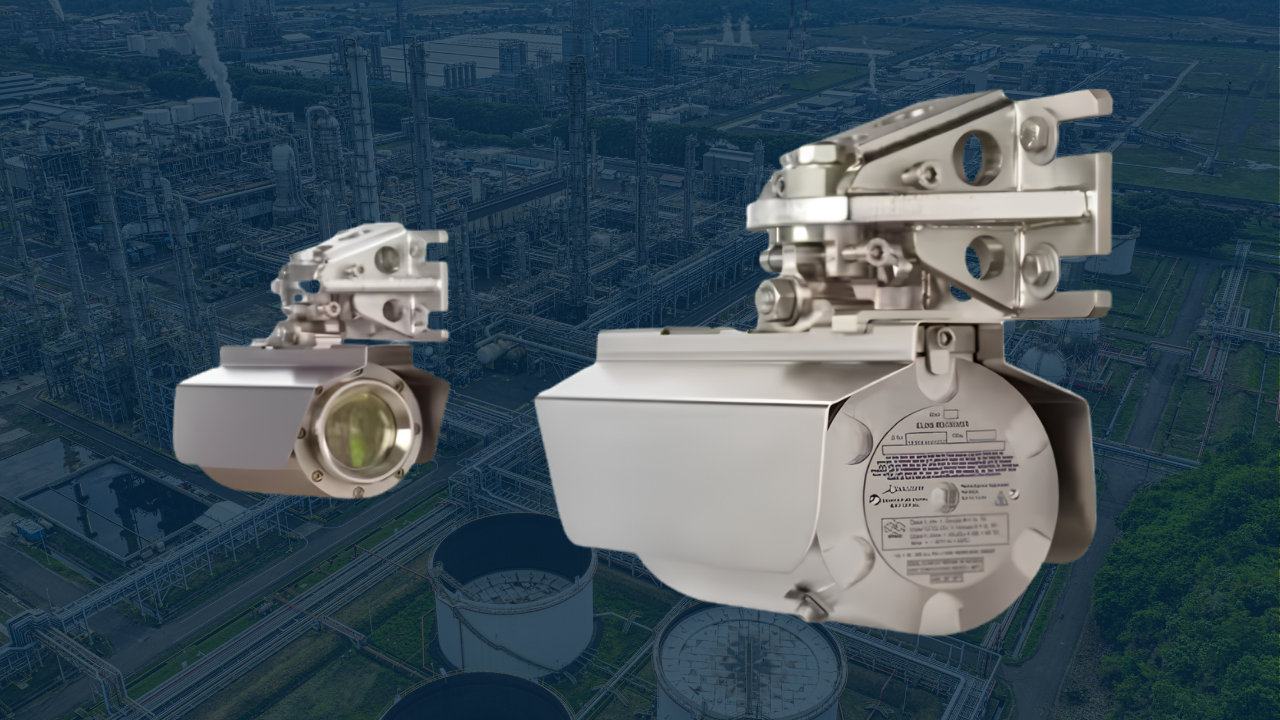
Fixed gas detection often uses sensors positioned at locations where a release is considered likely or where gas could accumulate. In large, open or highly ventilated industrial areas, however, predicting exactly where a gas cloud will travel can be difficult.
Open-path gas detection provides another approach. Instead of measuring gas concentration at a single location, it uses an optical beam between a transmitter and receiver to monitor for a target gas across a defined path.
This can make the technology useful around process equipment, storage areas and other industrial locations where wider line-of-sight monitoring is required.
What Is Open-Path Gas Detection?
An open-path gas detector uses an optical beam to detect a target gas along the line of sight between a transmitter and receiver.
The target gas absorbs light at characteristic wavelengths. By analysing changes in the transmitted light before it reaches the receiver, the detector can determine whether that gas is present within the optical path.
Unlike a point detector, the measurement therefore represents gas encountered across the beam path, rather than concentration at one sensor location.
Open-path systems commonly report a path-integrated concentration, using units such as ppm·m or LEL·m. This represents gas concentration multiplied by the length of the gas cloud intersecting the beam; it does not mean that concentration exists uniformly across the entire path.
How Does Open-Path Gas Detection Work?
The precise sensing method varies between technologies. MSA's Senscient ELDS uses Enhanced Laser Diode Spectroscopy (ELDS).
A transmitter directs a laser beam towards a receiver across the area being monitored. If the target gas crosses the optical path, it absorbs energy at characteristic wavelengths. The receiver analyses this absorption signal to identify the target gas and determine its path-integrated concentration.
In simple terms:
Laser transmitter → gas crosses optical path → characteristic absorption → receiver analyses signal → gas measurement → system output
Senscient ELDS also uses MSA's Harmonic Fingerprint™ technology, which analyses multiple identifiers in the absorption response to distinguish the target gas from potential interferents. The supplied MSA documentation also describes a target-gas reference cell used to maintain the wavelength reference.
Open-Path vs Point Gas Detection
Both technologies detect gas, but their coverage principles differ.
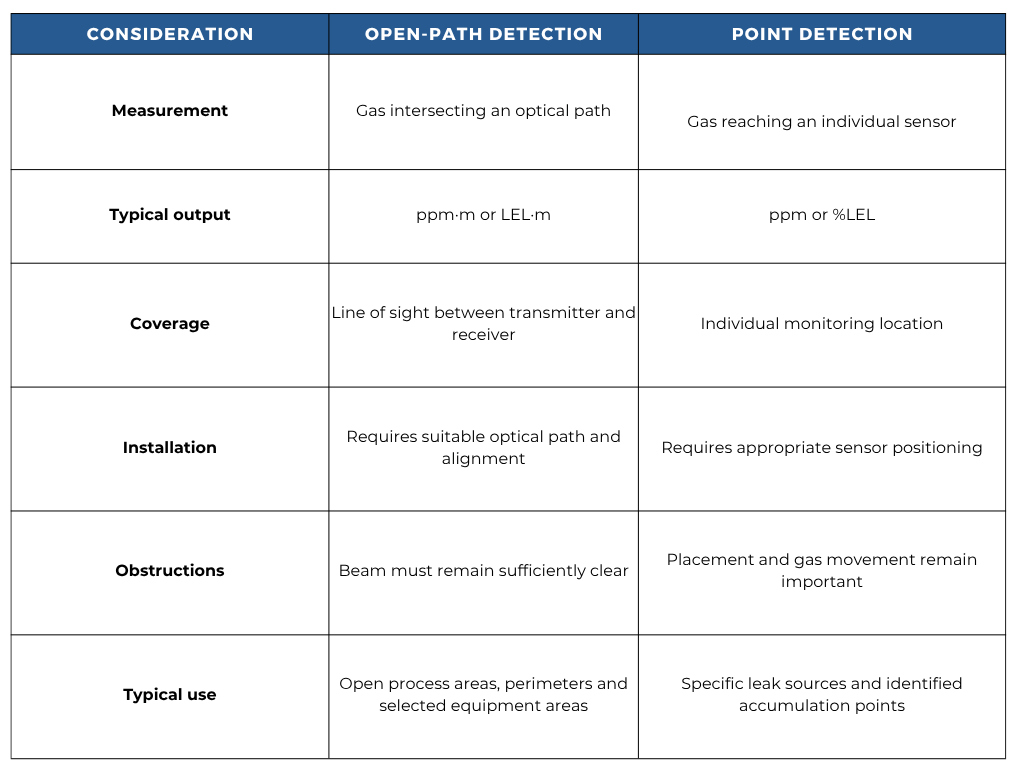
Open-path detection should not automatically be viewed as a replacement for point detectors. The two approaches can complement each other.
A point detector may be appropriate where a specific leak source or accumulation location can be identified. Open-path detection can provide additional coverage where gas movement is less predictable or a longer monitoring path is required.
Understanding Path-Integrated Measurements
Path-integrated concentration is one of the most important concepts when working with open-path detection.
For example, if a gas cloud measuring 10 m across intersects the beam and contains an average concentration of 10 ppm:
10 ppm × 10 m = 100 ppm·m
A narrower cloud at a higher concentration could potentially produce the same integrated measurement.
An open-path reading therefore should not be interpreted as the concentration at every point between the transmitter and receiver. This distinction needs to be considered when establishing alarm levels and integrating the detector into the wider gas detection strategy.
Where Is Open-Path Gas Detection Used?
The supplied MSA material describes open-path detectors positioned around the perimeter of plant, process or storage areas, or close to equipment presenting a credible gas-release risk, including compressors, pumps, pressure reducers, valves and pipe flanges.
Applications can therefore include oil and gas processing, petrochemical facilities, refineries, tank and storage areas, utilities and other large industrial process environments.
The benefit comes from the coverage principle rather than simply the size of the site. Wind, ventilation and release conditions can affect the direction of a gas cloud. If that cloud intersects the optical beam, an open-path detector can identify the target gas without requiring it to travel directly to an individual point sensor.
However, the detector only monitors gas that intersects its optical path. It should not be interpreted as providing uniform detection throughout an entire area.
What Affects Open-Path Detection Performance?
Several factors need to be considered when designing an open-path system.
Target gas
The detector must be configured for the gas being monitored because different gases absorb radiation at different wavelengths.
Senscient ELDS configurations are available for a range of toxic and flammable gases, including methane and hydrogen sulphide. The supplied datasheet covers a sour-gas configuration designed for CH₄ and H₂S.
Path length
The required transmitter-to-receiver distance must fall within the specification of the selected detector and gas configuration.
For example, the supplied Senscient ELDS sour-gas datasheet specifies a 5–60 m path length.
This should not be treated as a universal range for every open-path detector or every Senscient configuration.
Alignment and obstructions
The transmitter and receiver require an appropriate optical line of sight. Structures, vehicles, equipment or other objects that interrupt the beam can affect operation.
Detector positioning therefore needs to account for both permanent structures and activities that could periodically obstruct the optical path.
Environmental conditions
Fog, rain, snow, dust and other atmospheric conditions can attenuate an optical signal. Temperature and contamination of the optics may also influence detector performance.
These factors need to be considered against the environmental specifications of the selected equipment rather than assuming that all laser-based systems perform identically.
Installation geometry
Detector height, beam direction, likely release points, prevailing conditions and plant layout all influence whether a gas release is likely to intersect the optical path.
A manufacturer's maximum path length should therefore not be treated as a recommended detector spacing.
What Should Engineers Consider When Specifying Open-Path Detection?
Specification should start with the gas hazard and credible release scenarios rather than the detector's maximum range.
Questions to consider include:
- Which gas or gases need to be detected?
- Where could releases originate?
- How could gas disperse under different operating and weather conditions?
- What area needs monitoring?
- What optical path can realistically be maintained?
- Could structures, vehicles or equipment obstruct the beam?
- What environmental conditions will the equipment experience?
- What measurement range and response characteristics are required?
- How will alarms and outputs integrate with the wider control or safety system?
- How will the equipment be inspected, tested and maintained?
- What hazardous-area and functional-safety requirements apply?
For more complex installations, detector positioning should form part of an application-specific engineering assessment.
MSA Senscient ELDS
The MSA Senscient ELDS™ is a laser-based open-path gas detection platform designed for monitoring selected toxic and flammable gases.
The technology uses Harmonic Fingerprint™ analysis to help distinguish the target gas from potential interferents. The supplied sour-gas version simultaneously addresses CH₄ and H₂S and specifies a 5–60 m optical path and T90 response time of ≤3 seconds.
These figures are specific to the documented configuration and should be checked against current manufacturer documentation when specifying a system.
Where Shawcity Fits In
Open-path gas detection is ultimately a system-design decision. Target gases, credible release scenarios, dispersion, optical paths, surrounding plant and integration requirements all influence whether the technology is appropriate and where detectors should be positioned.
Shawcity supports organisations with the specification, supply, installation, commissioning, service and maintenance of fixed gas detection systems, working with technologies from manufacturers including MSA.
If you're reviewing existing gas detector coverage, considering open-path detection for a new application or planning an upgrade, our Fixed Systems team can help assess the application and determine an appropriate monitoring approach.
Speak to Shawcity about your fixed gas detection requirements.





 01367 899553
 info@shawcity.co.uk