

Optical flame detectors are designed to identify the characteristic radiation produced by a fire. But not all flame detectors analyse that radiation in the same way.
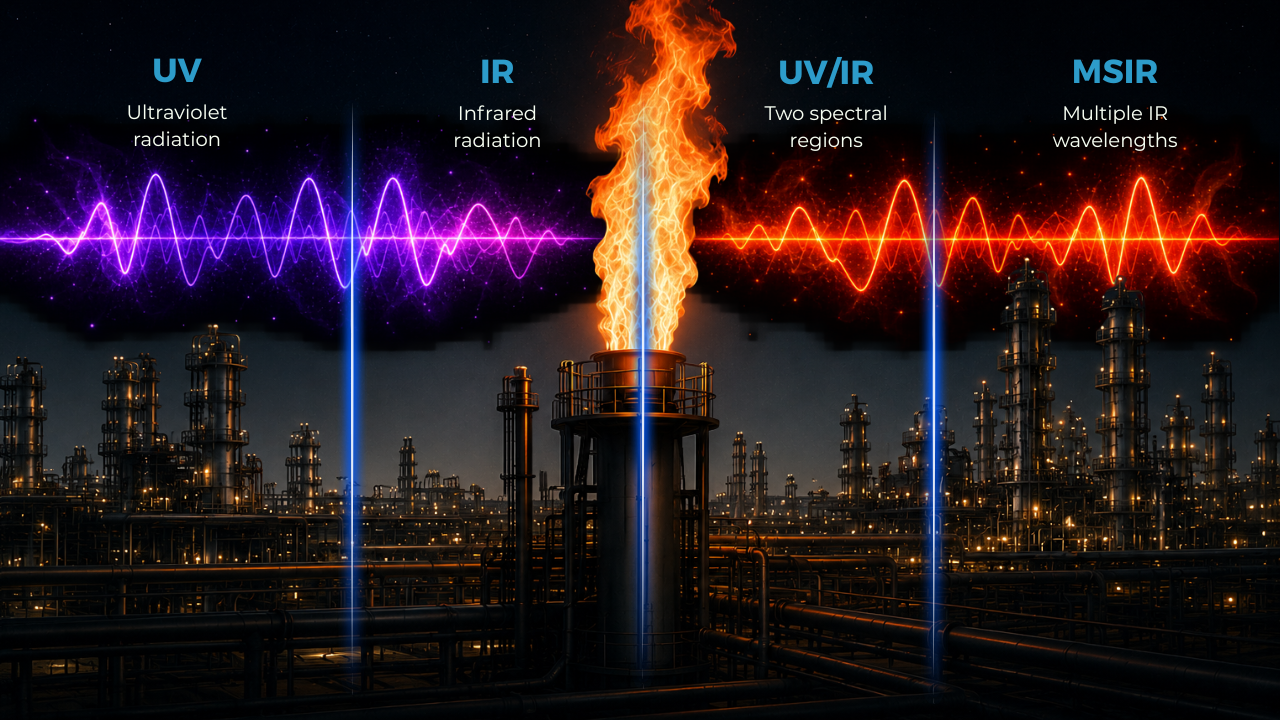
Two technologies commonly used in industrial applications are ultraviolet/infrared (UV/IR) and multi-spectrum infrared (MSIR). Both are designed to detect flames rapidly while distinguishing them from other sources of radiation, but they use different parts of the electromagnetic spectrum and different approaches to signal analysis.
Understanding these differences can help when selecting flame detection for process plants, fuel handling areas, oil and gas facilities and other high-hazard environments.
How Does Optical Flame Detection Work?
A flame produces electromagnetic radiation across different wavelengths, including ultraviolet (UV) and infrared (IR).
Optical flame detectors monitor selected regions of this radiation. Their electronics analyse the signals received by the sensors and determine whether their characteristics are consistent with a fire.
In simple terms:
Flame → characteristic radiation → optical sensors → signal processing → alarm decision
The spectral characteristics of a flame depend partly on the fuel being burned. Hydrocarbon and hydrogen fires, for example, do not produce identical signatures.
This is an important consideration when specifying a detector. A detector designed and tested for one fuel should not automatically be assumed suitable for another.
How Does UV/IR Flame Detection Work?
A UV/IR flame detector monitors two different regions of the electromagnetic spectrum: ultraviolet and infrared.
The UV sensor responds to ultraviolet radiation produced by a flame, while the IR sensor monitors flame-associated infrared radiation. The detector evaluates information from both spectral regions when determining whether the observed radiation is consistent with a fire.
Combining the two regions provides more information than relying on either UV or IR sensing alone and can improve immunity to potential false-alarm sources.
The wavelengths monitored depend on the detector and the fuel it is designed to detect.
For example, the MSA General Monitors FL500-H2 is specifically designed for hydrogen flame detection. Its UV sensor operates between 185 and 260 nm, while its IR sensor monitors radiation at 2.95 μm. MSA specifies detection of a hydrogen flame at up to 18 m under its defined test conditions, with a response time of less than three seconds.
The fuel-specific design is significant. The spectral characteristics used to identify hydrogen are different from those associated with a typical hydrocarbon fire, so detector selection needs to reflect the actual fire hazard.
How Does MSIR Flame Detection Work?
Multi-Spectrum Infrared takes a different approach.
Rather than combining UV and IR sensing, MSIR monitors multiple regions within the infrared spectrum. The detector can compare information across those spectral regions and use signal-processing algorithms to distinguish a flame from other sources of radiation.
The MSA General Monitors FL5000, for example, is an MSIR detector. MSA states that it combines infrared detectors with an advanced flame-detection algorithm using artificial neural network (ANN)-based signal processing.
According to the manufacturer, this is designed to provide immunity to potential false-alarm sources including lightning, reflected sunlight, arc welding and hot objects.
The FL5000 operates across a specified IR spectral range of 2–5 μm.
The important distinction is therefore the information available to the detector: UV/IR evaluates radiation from ultraviolet and infrared regions, whereas MSIR analyses information across multiple infrared spectral regions.
UV/IR vs MSIR: The Key Differences
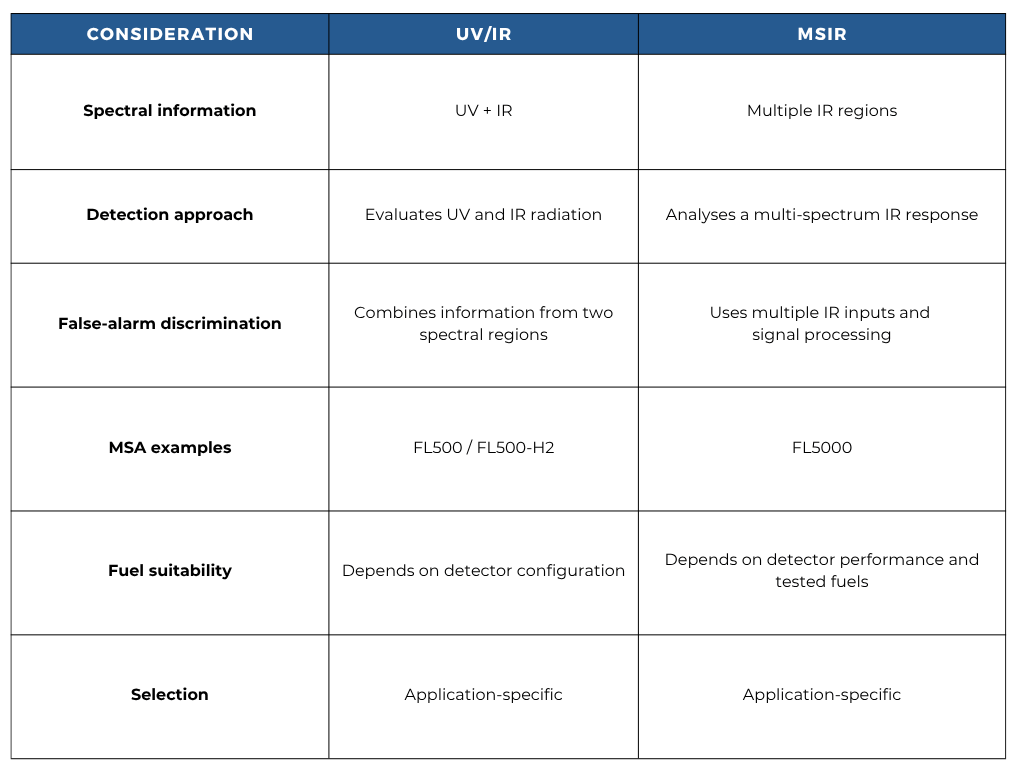
This comparison should not be interpreted as MSIR automatically being the better technology.
Both approaches are established methods of industrial flame detection. The appropriate choice depends on the fire hazard, environment, required coverage and potential sources of interference.
What About False Alarms?
Industrial sites can contain many sources of electromagnetic radiation that are unrelated to fire.
Depending on the technology and application, these can include welding, hot equipment, sunlight or reflected sunlight, lightning and other radiation sources.
Flame detector manufacturers therefore use combinations of spectral selection and signal processing to help distinguish genuine flame characteristics from potential interference.
With UV/IR, monitoring two different spectral regions provides additional information compared with a single-spectrum detector. MSA describes the combination of UV and IR sensing in the FL500-H2 as providing increased immunity.
With the FL5000, MSA uses multiple IR inputs combined with ANN-based processing specifically to improve discrimination against potential false-alarm sources.
No detector should, however, be treated as universally immune to unwanted alarms. Performance needs to be considered in the context of the intended application.
Does MSIR Mean Longer Detection Range?
Not necessarily.
Detection range depends on the individual detector, fuel, fire size, field of view, sensitivity and test conditions. It should not be assumed solely from whether a detector uses UV/IR or MSIR technology.
The FL5000 demonstrates the performance available from one particular MSIR implementation. Its datasheet specifies a maximum detection range of 95 m (310 ft), with field of view varying according to distance: ±15° at 95 m, ±30° at 64 m and ±45° at 34 m.
MSA also lists 22 FM performance-tested fuel sources for the FL5000, including methane, propane, diesel, crude oil, methanol and several aviation fuels.
These figures should not be directly compared with the FL500-H2's 18 m hydrogen specification to conclude that MSIR inherently provides greater range. They relate to different detectors, fuels and defined test conditions.
Published maximum ranges should also not be treated as universal detector-spacing recommendations.
Which Technology Should You Choose?
Selecting between UV/IR and MSIR should start with the application rather than the detector technology.
Key considerations include:
- Fuel: Which substances could burn, and has the detector been tested for them?
- Fire scenario: What type and size of fire needs to be detected?
- Detection distance: How far is the detector from the area requiring protection?
- Field of view: What coverage can the detector provide at the required distance?
- Interference: Are welding, hot equipment or other optical sources present?
- Environment: Will the detector be exposed to weather, contamination or extreme temperatures?
- Obstructions: Could equipment or structures interrupt the detector’s view?
- Response: What detection performance is required by the application?
- System integration: How will the detector communicate with the wider fire and gas system?
Considering these factors allows individual detector specifications to be compared against the actual hazard rather than selecting equipment based on technology alone.
MSA UV/IR and MSIR Flame Detection
MSA’s General Monitors range provides examples of both approaches.
The FL500 uses UV/IR technology for hydrocarbon flame detection, while the FL500-H2 applies UV/IR sensing specifically to hydrogen. The FL500-H2 also incorporates Continuous Optical Path Monitoring (COPM), which performs an optical and electrical self-check every two minutes.
The FL5000 uses MSIR technology with advanced signal processing. Its datasheet also specifies Continuous Optical Path Monitoring, along with heated optics designed to reduce frost and condensation. 1466-27-MC_FL5000-Flame-Detecto…
These products demonstrate two different approaches to optical flame detection rather than establishing a universal hierarchy between the technologies.
Where Shawcity Fits In
Selecting flame detection involves more than comparing product specifications. Fuel type, credible fire scenarios, detection distance, field of view, potential interference, environmental conditions and site geometry all influence system design.
Shawcity supports organisations with the specification, supply, installation, commissioning, service and maintenance of fixed gas and flame detection systems, working with manufacturers including MSA.
Whether you are comparing UV/IR and MSIR technologies, reviewing existing flame detector coverage or planning a new installation, our technical team can help assess the application and determine an appropriate detection approach.
Speak to Shawcity about your flame detection requirements.





 01367 899553
 info@shawcity.co.uk