

Selecting a gas sensor for industrial equipment requires careful consideration of the target gas, measurement accuracy, environmental conditions and integration requirements.
For OEM manufacturers developing fixed or portable gas detection equipment, the sensing technology influences instrument performance, reliability and long-term maintenance.
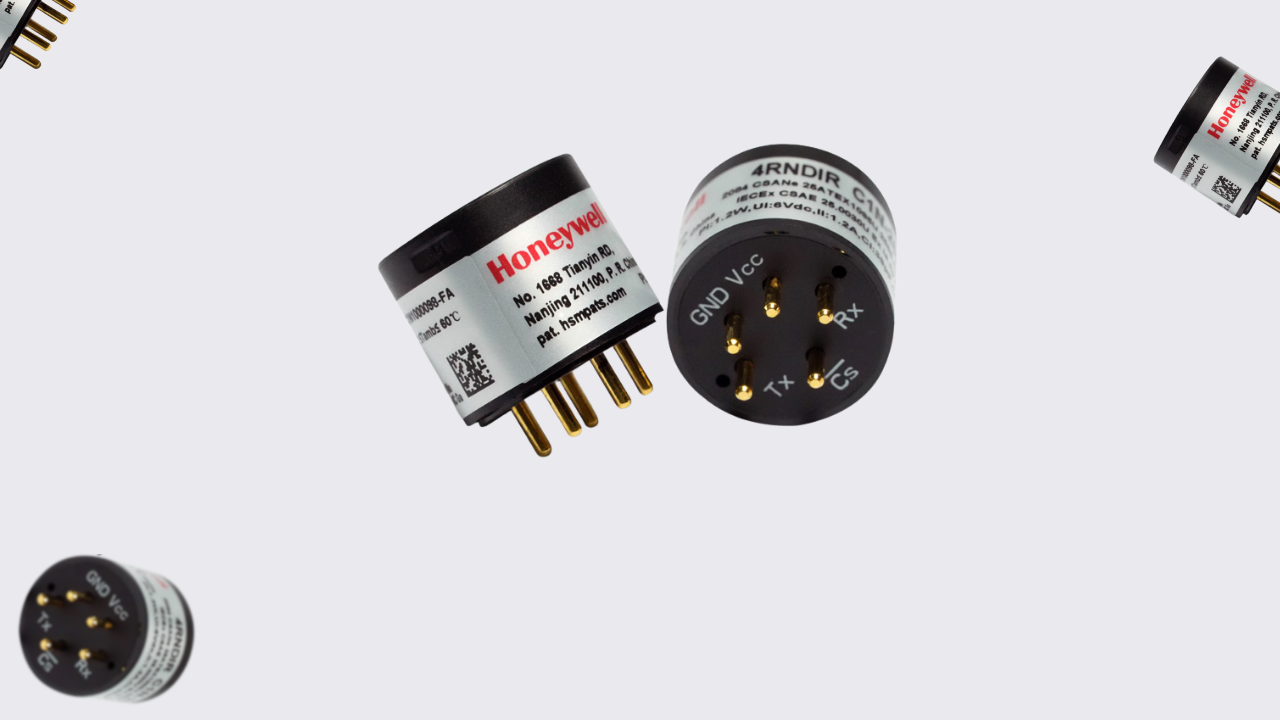
The Honeywell 4-Series NDIR Hydrocarbon Gas Sensor uses non-dispersive infrared (NDIR) technology to measure selected flammable hydrocarbons. Its compact design, digital communication and configurable gas selection make it suitable for consideration in a range of OEM gas detection applications.
What Is the 4-Series NDIR Hydrocarbon Gas Sensor?
The Honeywell 4-Series NDIR, also identified as the 4R NDIR, is an infrared sensing component designed to measure flammable hydrocarbon concentrations from 0–100% of the lower explosive limit (LEL).
LEL refers to the minimum concentration of a flammable gas or vapour in air capable of supporting combustion under specified conditions.
The sensor is factory-calibrated for methane but can be configured for six saturated straight-chain hydrocarbons:
- Methane (CH₄)
- Ethane (C₂H₆)
- Propane (C₃H₈)
- Butane (C₄H₁₀)
- Pentane (C₅H₁₂)
- Hexane (C₆H₁₄)
Two variants are available:
C1N-2654-400: Temperature- and humidity-compensated output.
C1N-2654-40D: Adds pressure compensation and an automatic condensation-reduction function.
Both communicate through a digital UART interface with chip select.
How Does NDIR Gas Sensing Work?
NDIR technology measures how gas molecules absorb infrared radiation at characteristic wavelengths.
An infrared source directs radiation through a gas sample. Compatible molecules absorb some of this energy, changing the signal received by the detector.
The sensor processes this signal using calibration information to calculate gas concentration.
Many hydrocarbons absorb infrared radiation, making NDIR suitable for measuring gases such as methane and propane.
However, NDIR cannot directly detect every flammable gas. Hydrogen, for example, does not exhibit the infrared absorption required by conventional hydrocarbon NDIR sensors.
Different hydrocarbons can also produce different responses, making correct gas selection and calibration essential.
Key Technical Features
Honeywell's 4-Series NDIR combines several capabilities relevant to OEM equipment design.
| Specification | Honeywell 4-Series NDIR |
|---|---|
| Measurement range | 0–100% LEL |
| Accuracy: methane and propane | ±2% LEL or ±5% of reading |
| Accuracy: other specified gases | ±5% LEL or ±10% of reading |
| T90 response time | ≤30 seconds |
| Warm-up time | Under 30 seconds |
| Communication | UART with chip select |
| Operating temperature | −20°C to +60°C |
| Supply voltage | 3–5 V DC |
| Body diameter | 20.5 mm |
| Operating life | Over 10 years in air |
Configurable Gas Measurement
The sensor supports six specified hydrocarbons, allowing OEMs to evaluate different gas configurations within the same sensing platform.
Performance specifications vary by gas, so manufacturers should review the relevant characterisation data.
Environmental Compensation
Both variants incorporate temperature and humidity compensation.
The C1N-2654-40D also includes pressure compensation and condensation reduction, which may be useful where environmental conditions fluctuate.
These features do not eliminate the need for suitable enclosure protection and environmental validation.
Digital Integration and Long Operating Life
UART communication allows the sensor to exchange information with a host instrument.
Honeywell specifies an operating life exceeding ten years in air. However, calibration, functional testing and maintenance remain necessary throughout its service life.
Where Can the 4-Series NDIR Be Used?
Fixed Gas Detection Systems
The sensor can be considered for fixed detectors monitoring supported flammable hydrocarbons in industrial environments.
Potential applications include natural gas installations, chemical processing facilities and hydrocarbon storage areas.
Complete detector performance depends on sensor positioning, gas access, enclosure design and alarm configuration.
Portable Gas Detection Equipment
Its compact dimensions and digital interface make the sensor relevant to portable instrument development.
OEM engineers must assess power consumption, battery capacity, response time and environmental protection when designing the complete instrument.
Oil, Gas and Petrochemical Operations
Equipment handling methane, propane or other supported hydrocarbons may require combustible gas monitoring.
The sensor's selectable gas configurations can support different applications, although mixed-gas atmospheres require additional consideration.
Refrigeration and Specialist Equipment
Honeywell identifies refrigeration among the sensor family's potential applications.
Suitability depends on the exact refrigerant. The sensor should not be assumed compatible with every refrigerant or hydrocarbon mixture.
What Should Engineers Consider During Integration?
Selecting the sensor is one stage of developing a complete gas detection instrument.
Key considerations include:
- Gas compatibility: Confirm the target gas and required calibration.
- Electrical integration: Assess supply voltage, power consumption and UART communication requirements.
- Mechanical design: Provide suitable mounting, gas access and environmental protection.
- Response time: Account for enclosure, filters and sampling arrangements.
- Calibration: Follow Honeywell's instructions for calibration and functional verification.
- Certification: Assess applicable requirements for the finished instrument.
Honeywell lists ATEX markings and relevant IEC/EN standards in its datasheet. However, component approvals do not automatically establish certification of the completed detector.
How Shawcity Can Support OEM Gas Sensor Selection
Shawcity supplies Honeywell gas sensing components for manufacturers developing industrial monitoring equipment.
The 4-Series NDIR offers configurable hydrocarbon measurement, digital communication and two environmental variants for different design requirements.
Our team can help you explore the available sensor options and discuss compatibility with your intended application.
Conclusion
The Honeywell 4-Series NDIR provides a compact infrared sensing solution for selected flammable hydrocarbons.
Its configurable gas selection, 0–100% LEL measurement range and UART interface make it relevant to OEM gas detection development.
Successful integration depends on matching the sensor to the target gas, operating conditions and requirements of the complete instrument.
Explore the Honeywell 4-Series NDIR Hydrocarbon Gas Sensor or contact Shawcity to discuss your OEM sensing requirements.




 01367 899553
 info@shawcity.co.uk