

Key Takeaways
- Farmer's Lung is one of the most common occupational forms of Extrinsic Allergic Alveolitis (EAA), caused by an allergic reaction to mould spores from damp hay, straw, and grain.
- Once sensitised, even small exposures can trigger severe reactions — early prevention is critical.
- Chronic Farmer's Lung causes permanent, irreversible lung scarring (fibrosis), with no cure.
- Engineering and administrative controls should always take priority over respiratory protective equipment (RPE).
- Tight-fitting RPE, including FFP3 respirators, must be fit tested on every individual wearer.
Introduction
Farmer's Lung is a serious but largely preventable occupational health condition affecting workers who regularly handle mouldy hay, straw, and grain. It develops silently, often over months or years, and left unmanaged can progress to irreversible lung damage and permanent disability. For agricultural employers, understanding and managing this risk is both a legal duty and a duty of care.
What Is Farmer's Lung?
Farmer's Lung is an occupational form of Hypersensitivity Pneumonitis (HP), also known as Extrinsic Allergic Alveolitis (EAA). It's triggered by inhaling spores from thermophilic actinomycetes and moulds — principally Saccharopolyspora rectivirgula, Thermoactinomyces vulgaris, and certain Aspergillus species — which thrive on damp hay, straw, and grain.
The disease develops in two stages: first sensitisation, where the immune system produces antibodies with little or no symptoms; then, on later exposure, a hypersensitive inflammatory reaction that damages lung tissue. Sensitisation can take months or years to develop, but once established, further exposure — even at low levels — can trigger severe, cumulative harm. Genetic susceptibility varies between individuals, so protective measures must apply consistently to all workers, not selectively.
Where Does Exposure Occur?
Exposure arises wherever damp or poorly dried organic material is disturbed:
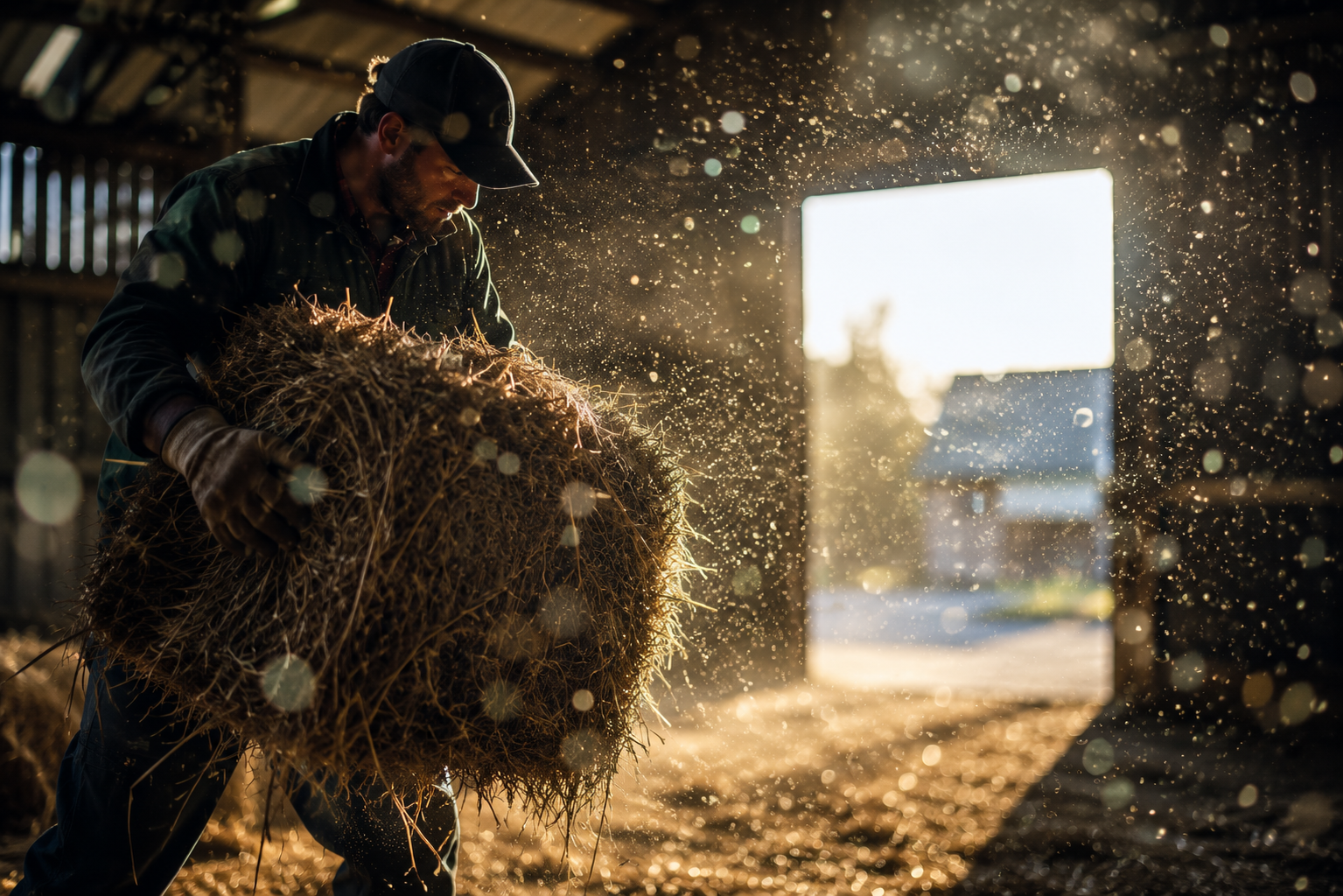
- Hay and straw handling (turning, loading, moving bales)
- Grain silos and stores, especially during emptying or inspection
- Livestock bedding and mucking out
- Silage and contaminated feed handling
- Threshing and harvesting damp crops
- Enclosed or poorly ventilated agricultural buildings
- Composting and organic waste
Risk peaks in autumn/early winter (damp harvests entering storage) and late winter/spring (stored material being distributed).
Symptoms and Long-Term Health Effects
- Acute (~1 in 3 cases): flu-like symptoms 4–8 hours after exposure — fever, breathlessness, cough, aches. Often mistaken for a chest infection. Usually resolves within days to weeks if exposure stops.
- Sub-acute: develops over weeks/months — progressive breathlessness, persistent cough, fatigue, weight loss.
- Chronic: permanent lung fibrosis with irreversible loss of lung function, chronic breathlessness, and disability. There is no cure — steroids may ease inflammation but cannot reverse fibrosis; lung transplant may be a last resort.
The earlier exposure is eliminated, the greater the chance of recovery. Workers with symptoms should be referred promptly to a GP or occupational health physician — health surveillance is a key COSHH duty.
Prevention and Exposure Control
Follow the hierarchy of controls — eliminate or reduce exposure at source first; use RPE as a supplementary measure only.
- Crop drying and storage: Dry hay below 20% moisture before baling; monitor grain moisture and use appropriate drying/aeration.
- Ventilation: Maintain mechanical and natural ventilation in barns and stores; avoid enclosed, unventilated spaces when handling mouldy material.
- Work planning: Minimise the number of workers and duration of exposure; work outdoors where possible; rotate tasks; dampen dusty material before handling.
- Housekeeping: Never use compressed air or dry brushing (this redistributes spores) — use filtered vacuum or wet methods; clean cab filters and ventilation ducting regularly.
- Training: Ensure workers understand the risks, recognise symptoms, and know how to use RPE correctly.
Respiratory Protection and Fit Testing
Where exposure can't be adequately controlled by other means, RPE is essential. HSE guidance favours proper dust respirators over simple dust masks, which offer little protection against fine spores. Suitable options include FFP3-rated disposable respirators, half-mask respirators with P3 filters, and powered air-purifying respirators (PAPRs), which don't require fit testing.
Fit testing is a legal requirement under COSHH for all tight-fitting RPE — before first use of a new respirator type, when facial characteristics change, when the mask model changes, and at least every two years as routine practice. Testing must be done by a competent person, with results recorded.
Two accepted methods exist: qualitative (QLFT), relying on the wearer detecting a test agent, and quantitative (QNFT), using instruments to measure an objective fit factor — generally the more reliable method for higher-hazard environments.
Shawcity supplies the OHD QuantiFit 2, a market-leading quantitative fit tester using Controlled Negative Pressure testing — fast, aerosol-free, and well suited to agricultural settings. [Explore Shawcity's respiratory protection resources →]
Exposure Monitoring
Air quality and dust monitoring provides the objective data to quantify exposure, identify high-risk tasks, validate controls, and support COSHH assessments. It's especially valuable during grain handling, hay/straw work, animal housing management, and crop processing, or when introducing new processes or crops.
Grain dust carries a Workplace Exposure Limit (WEL) of 10 mg/m³ (8-hour TWA) under EH40 — a ceiling, not a target; exposure should be kept as low as reasonably practicable. No specific WEL exists for the mould spores causing Farmer's Lung, reinforcing that all agricultural dust exposure should be minimised.
Shawcity's Air Quality and Dust Monitoring range supports personal and area monitoring for agricultural exposure assessment. Browse Shawcity's Air Quality & Dust Monitoring range →
Employer Responsibilities
Under COSHH, employers must: assess exposure risk; prevent or adequately control it (favouring engineering controls over RPE); maintain and test control measures; train and inform workers; provide health surveillance where sensitisation risk exists; and keep records.
Duties also sit under the Health and Safety at Work etc. Act 1974, the PPE at Work Regulations 2022, and RIDDOR 2013 — Farmer's Lung is a RIDDOR-reportable disease where diagnosed occupational EAA/HP is linked to mouldy vegetable matter exposure.
Quick Compliance Checklist
- COSHH risk assessment reviewed annually
- Engineering controls and ventilation maintained
- Crop drying/storage procedures documented
- Workers trained on risks and symptoms
- RPE selected, issued, and fit tested — records kept
- Health surveillance programme in place
- Dust monitoring conducted where required
- RIDDOR reporting understood
Conclusion
Farmer's Lung is preventable, not inevitable. Because it develops silently and its chronic form is irreversible, reactive approaches come too late — by the time breathlessness is persistent, fibrotic damage may already exist. Proactive management — COSHH assessment, engineering and administrative controls, air quality monitoring, properly fitted RPE, and health surveillance — is the only reliable answer.
Shawcity supports agricultural businesses, H&S managers, and occupational hygienists with respiratory protection, quantitative fit testing, and air quality and dust monitoring solutions. Get in touch with our team to discuss your farm's exposure risks.
.png)

.png)

 01367 899553
 info@shawcity.co.uk