

Behind Every Scoop: The Serious Safety Science of Ice Cream Manufacturing
There's a reason National Ice Cream Month feels like a national holiday in spirit, and it's celebrated in the UK too. Ice cream is nostalgia in a tub, the sound of a van chime, a melting cone on a hot pavement, the squabble over who gets the last spoonful. It's hard to think of a more universally cheerful product.
But step behind the factory doors, and the story changes tone considerably. Producing the millions of litres of ice cream consumed every summer involves high-pressure ammonia refrigeration, sub-zero cold stores, confined mechanical spaces, and air quality risks that have nothing to do with whether you chose vanilla or pistachio. For the people who keep those production lines running, health & safety managers, engineers, facilities teams, occupational hygienists, ice cream is less "treat yourself" and more "respect the process."
So in honour of National Ice Cream Month, we're taking a tour through the unexpectedly serious engineering and safety considerations that sit behind something so simple and joyful.
The Hidden Science Behind Ice Cream
Commercial ice cream production looks deceptively straightforward: mix, freeze, scoop, sell. In reality, it's a precisely engineered process.
It typically starts with pasteurisation, heating the dairy-and-sugar mix to eliminate pathogens, followed by homogenisation, which breaks down fat globules so the product feels smooth rather than greasy. The mix is then aged in chilled tanks for several hours to let proteins and fats stabilise, before heading into a continuous freezer where it's whipped and rapidly frozen, incorporating air to create that soft, scoopable texture known in the industry as "overrun."
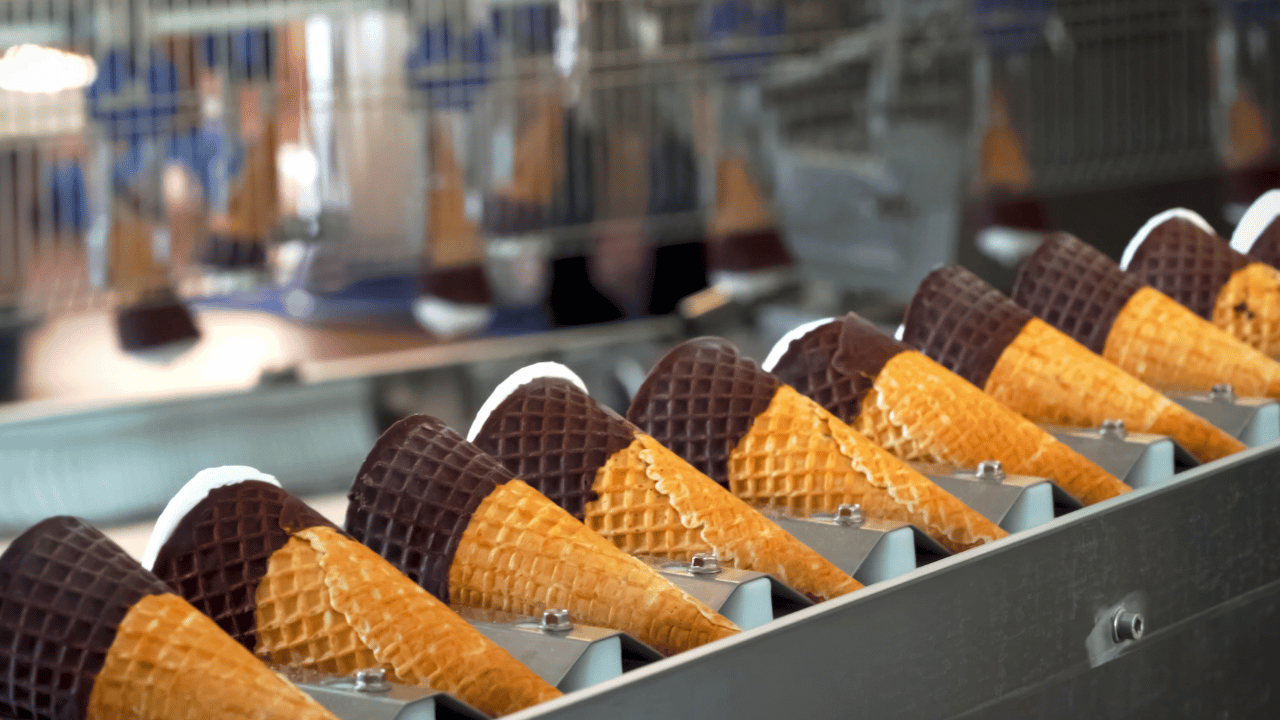
From there, the semi-frozen product is extruded, flavoured, mixed with inclusions like chocolate chips or fruit pieces, and packaged before passing into a hardening tunnel or blast freezer, where the temperature plunges to around -30°C to -40°C to lock the structure in place. Finally, it's moved into cold storage at roughly -18°C to -25°C until it's shipped.
Did You Know? The air whipped into ice cream during freezing can account for up to 50% of its volume. Without it, your "creamy" scoop would be closer to a dense ice block, which is exactly why premium and budget ice creams can taste and feel so different, even with similar ingredients.
Every one of those stages, pasteurisation, ageing, freezing, hardening, storage relies on tightly controlled temperature and, critically, on refrigeration systems that are themselves significant industrial hazards.
Why Ice Cream Manufacturing Presents Unique Safety Challenges
Most food manufacturing facilities deal with hygiene risks, slips, and machine guarding. Ice cream production adds an extra layer: it is fundamentally a cold chain business, and the colder and more continuous the chain needs to be, the more industrial the refrigeration becomes.
A typical ice cream plant might include:
- Ammonia or CO₂-based refrigeration systems running the blast freezers and hardening tunnels
- Confined or semi-confined plant rooms housing compressors and pressure vessels
- Cold stores and freezer warehouses where staff regularly move between sub-zero and ambient zones
- High-speed mixing, freezing, and packaging lines with their own mechanical and electrical hazards
- Strict food safety and HACCP requirements layered on top of all of the above
It's the combination of extreme cold, hazardous refrigerants, and continuous production pressure, especially during a summer demand spike that makes ice cream manufacturing a genuinely distinct safety environment, rather than just "food production but colder."
Refrigeration Systems and Ammonia Monitoring
Ammonia (NH₃) is one of the most efficient industrial refrigerants available, and it's been a mainstay of large-scale cold chain operations, including ice cream hardening tunnels and cold stores for over a century. It's also a serious occupational hazard if it leaks.
Here's why it matters so much. Ammonia has a distinctive, pungent odour and most people can detect it by smell at around 5–50 ppm. But by the time concentrations reach 300 ppm, it's classified by NIOSH as Immediately Dangerous to Life or Health (IDLH) capable of incapacitating someone within minutes. NIOSH's recommended exposure limit sits far lower, at 25 ppm averaged over a working day, with a short-term limit of 35 ppm. It's also flammable within a fairly narrow band of around 15–28% concentration in air, particularly when mixed with refrigeration lubricants.
Did You Know?
Ammonia is roughly 3–10% more energy-efficient than many synthetic refrigerants, according to the International Institute of Ammonia Refrigeration which is exactly why it remains so popular in industrial cold chains, ice cream included, despite the extra safety overhead it demands.
This is where fixed and portable gas detection earns its place at the heart of any ammonia refrigeration safety programme. Industry guidance typically calls for:
- Fixed detectors in compressor and plant rooms, calibrated to alarm at around 25 ppm and trigger emergency ventilation or evacuation protocols at 150 ppm
- Redundant sensors in high-risk zones like compressor rooms, given the potential for a catastrophic release
- Portable detectors carried by maintenance personnel entering or working near refrigeration plant
- A documented calibration and bump-testing schedule, since a detector that hasn't been verified is really just decoration
Shawcity, as a long-standing channel partner for City Technology sensors, supplies the fixed and portable gas detection equipment, including dedicated ammonia sensors used across food and beverage cold chain facilities to keep these systems honest. Within Shawcity's fixed gas detection range, plant rooms and compressor areas are typically specified with fixed sensor detectors for point-source monitoring, refrigerant leak detection units tuned to the specific refrigerant in use (ammonia, CO₂, or synthetic blends), and control panels that tie everything together into a single alarm and ventilation trigger. For larger plant rooms or open compressor halls, open path gas detection can also cover wider areas than a point sensor alone, while acoustic gas detection adds another layer for high-pressure leak scenarios where sound, not just concentration, gives the earliest warning. The goal isn't just compliance on paper; it's making sure that if ammonia does escape its closed loop, someone knows about it long before it becomes a 300 ppm problem.
Protecting Workers in Cold Storage Environments
Ammonia gets the headlines, but the cold itself is a hazard that's easy to underestimate precisely because it's so familiar for everyone stood in a chilly freezer aisle. Working in one for an eight-hour shift is a different proposition entirely.
Cold storage and hardening tunnel environments commonly run between -18°C and -40°C. At those temperatures, cold stress including hypothermia, frostbite, and chilblains, becomes a real occupational risk, and research has also linked sustained cold exposure to elevated rates of musculoskeletal complaints, with one 2023 study finding cold storage workers at higher risk of neck, shoulder, and lower back pain than colleagues working in moderate temperatures.
There's also the more mundane but persistent hazard of condensation-driven slips, reduced visibility from breath fog and frosted equipment, and the confined-space considerations that come with plant rooms and tunnel access points.
Did You Know?
Some modern cold storage facilities now use turret trucks and automated retrieval systems specifically to reduce how long any individual worker spends in deep-freeze zones, rotating staff through shorter, less exposed shifts rather than long stints in the cold.
Good practice here typically includes layered, insulated PPE; scheduled warm-up breaks; buddy systems for lone work in freezer zones; and increasingly environmental monitoring that tracks not just gas levels but temperature and occupancy, so facilities teams have an evidence base for shift planning rather than relying on guesswork.
Monitoring Air Quality and Workplace Safety
Beyond ammonia, ice cream production facilities generate a surprisingly broad air quality profile. Boiler rooms and CO₂-based refrigeration introduce carbon dioxide risks; cleaning-in-place (CIP) systems use chemicals that need their own exposure controls; and confined spaces, pits, tanks, plant rooms carry oxygen depletion or toxic gas risks that have nothing to do with the refrigerant itself.
This is why a credible occupational hygiene programme in food manufacturing rarely monitors just one gas. A well-specified system might track:
- Ammonia (NH₃) in refrigeration and plant areas
- Carbon dioxide (CO₂), particularly where CO₂ refrigeration or dry ice handling is used
- Oxygen levels in confined or enclosed spaces
- Combustible gas (LEL) where flammability risk exists
Shawcity's broader portfolio built on City Technology's sensor range covering more than 30 gases supports exactly this kind of multi-gas approach, whether that's a single portable detector for a technician entering a plant room, or a fixed, networked system monitoring an entire production hall continuously. The principle is the same either way: you can't manage what you can't measure, and in an environment built on tightly controlled temperature, "measuring" has to extend to the air people are actually breathing.
How Technology Helps Keep Ice Cream Safe
It's worth pausing on the food safety side too, since temperature monitoring does double duty: it protects workers and it protects the product. A hardening tunnel that drifts a few degrees warm doesn't just risk a quality issue sustained temperature excursions can affect microbiological safety and shelf life, which is precisely why HACCP plans for frozen dessert production lean so heavily on continuous, documented temperature control.
The same instinct that drives gas detection continuous, automated, calibrated monitoring rather than periodic spot-checks applies to temperature. Modern facilities increasingly combine:
- Networked temperature sensors across freezers, tunnels, and cold stores, with automated alerts for drift
- Fixed gas detection integrated into building management or SCADA systems, so an ammonia or CO₂ alarm triggers ventilation automatically rather than waiting for a human to notice typically achieved through a networked control panel linking fixed sensor detectors across plant rooms, tunnels, and cold stores into one alarm strategy
- Data logging that creates an audit trail for both food safety compliance and process safety management documentation
None of this is glamorous. But it's the unglamorous, unseen monitoring infrastructure that allows the genuinely fun part of the business, the flavour development, the seasonal launches, the National Ice Cream Month marketing to happen without anyone getting hurt.
What Manufacturers Should Consider During Peak Demand Seasons
Ice cream is a deeply seasonal product, and that seasonality creates its own safety pressure. Summer demand spikes typically mean longer production runs, more frequent door openings on cold stores (and therefore more thermal cycling and condensation), increased maintenance demand on refrigeration plant running closer to capacity, and sometimes temporary or agency staff who are less familiar with site-specific cold chain and confined space procedures.
A few practical considerations worth a fresh look ahead of peak months:
- Recalibrate, don't assume. Fixed and portable gas detectors should be on a documented calibration and bump-test schedule, peak season is the worst time to discover a sensor has drifted.
- Review refrigeration plant maintenance against increased run time. Compressors and relief valves working harder are more likely to reveal weaknesses.
- Refresh induction training for seasonal staff on cold stress symptoms, PPE requirements, and what to do if a gas alarm sounds.
- Stress-test ventilation and emergency response plans for plant rooms and cold stores, particularly if production volumes are pushing close to capacity.
Conclusion
Ice cream is one of the simplest pleasures food manufacturing produces and one of the more demanding ones to make safely. Behind every tub is a closed loop of ammonia or CO₂ refrigeration running under pressure, a cold chain that has to hold its nerve from -40°C hardening tunnels to -18°C storage, and a workforce that depends on calibrated detectors, sound ventilation, and well-designed PPE to do their jobs without harm.
This National Ice Cream Month, enjoy the scoop. But spare a thought or better, a proper gas detection and temperature monitoring strategy for the engineering and safety professionals making sure that scoop reaches you the way it's supposed to: safely, consistently, and without anyone in the plant room having a far worse day than you are.
If your facility's ammonia monitoring, cold storage safety equipment, or air quality programme could use a review ahead of peak season, Shawcity's team is happy to talk through what's appropriate for your site.





 01367 899553
 info@shawcity.co.uk