

Engineered stone is widely used for kitchen worktops, bathrooms and commercial surfaces because of its durability and consistent finish. However, its high crystalline silica content presents a significant occupational health risk when the material is cut, ground, polished or drilled.
Understanding the risks and controlling exposure to respirable crystalline silica (RCS) is essential for businesses working with engineered stone.
Why Does Engineered Stone Present a Silicosis Risk?
Engineered stone is a composite material made from crushed quartz, resins and pigments. It can contain more than 90% crystalline silica, considerably more than many natural stones.
Mechanical processing can release microscopic RCS particles small enough to penetrate deep into the lungs. Prolonged exposure is associated with:
- Silicosis – an irreversible lung disease caused by scarring of lung tissue.
- COPD – including chronic bronchitis and emphysema.
- Lung cancer – crystalline silica is classified as a human carcinogen.
Processing engineered stone can also generate general airborne dust, while resins and other materials used during manufacture or installation may introduce additional contaminants such as volatile organic compounds (VOCs).
What Are the UK Regulations?
In the UK, exposure to RCS is controlled under the Control of Substances Hazardous to Health Regulations 2002 (COSHH).
The current UK Workplace Exposure Limit (WEL) for RCS is 0.1 mg/m³ as an eight-hour time-weighted average, as set out in HSE's EH40.
Importantly, the WEL should not be treated as a target. COSHH requires employers to prevent exposure where reasonably practicable or, where this is not possible, adequately control it and reduce exposure as far below the WEL as reasonably practicable.
Employers may also need to provide appropriate health surveillance for workers exposed to RCS.
Is Engineered Stone Banned in the UK?
No. Australia prohibited the manufacture, supply, processing and installation of engineered stone benchtops, panels and slabs from July 2024, followed by an import ban from January 2025.
The UK has not introduced an equivalent prohibition. RCS exposure is currently managed through COSHH, Workplace Exposure Limits and appropriate workplace controls.
Controlling RCS Exposure
Exposure controls should follow the hierarchy of control, with priority given to measures that prevent or reduce dust generation at source.
Depending on the process, these may include:
- Using alternative materials with lower silica content where practicable.
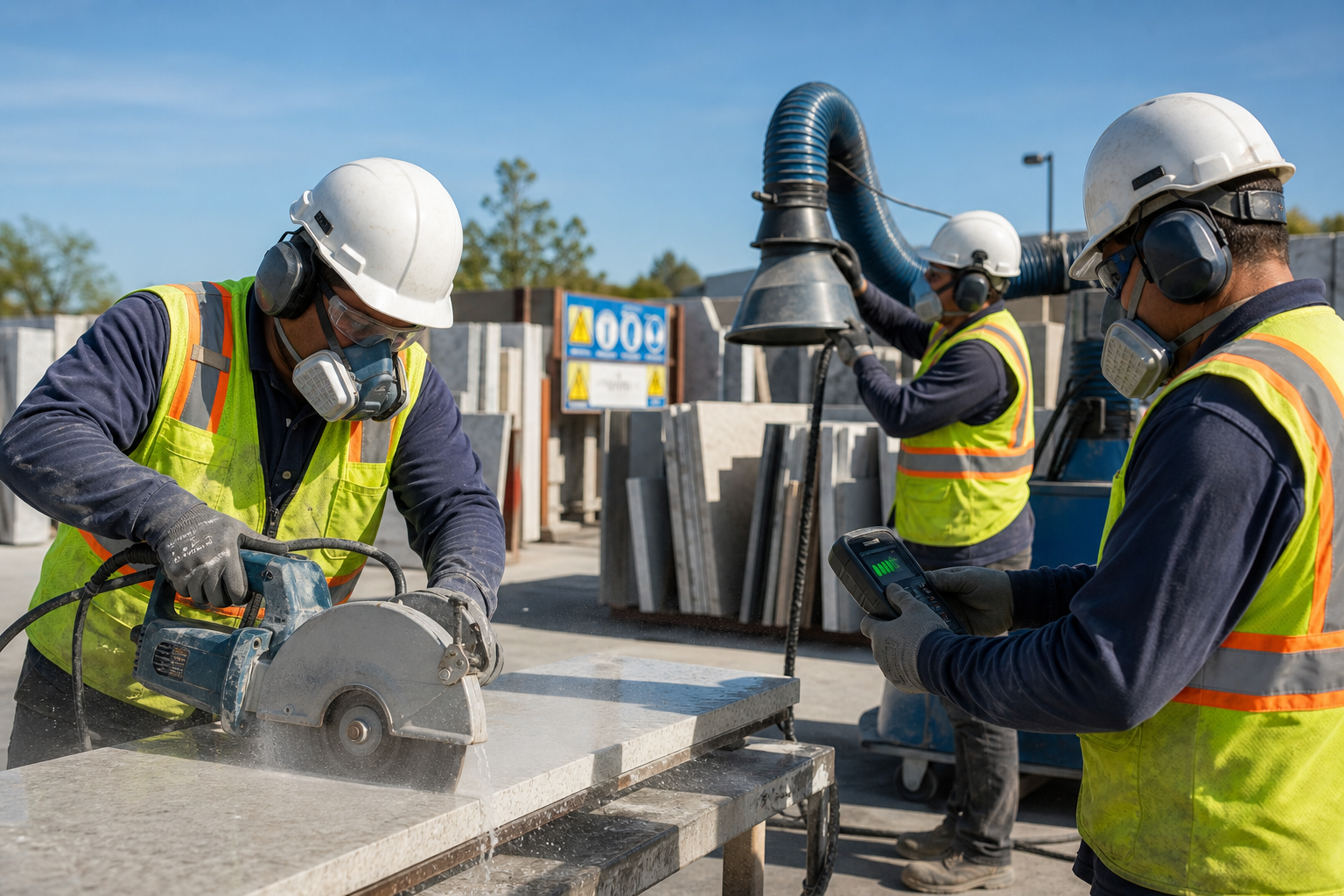
- Using wet-cutting techniques instead of dry processing.
- Installing Local Exhaust Ventilation (LEV) to capture dust close to its source.
- Providing appropriate training and limiting unnecessary exposure.
- Using suitable RPE, including face-fit-tested respiratory protection where required.
- Providing appropriate health surveillance.
No single control should be relied upon in isolation.
Monitoring RCS Exposure
Monitoring can help businesses understand whether their exposure controls are performing as intended and identify changes in airborne dust during different tasks.
The Trolex AIR XS Silica Monitor provides real-time, RCS-specific monitoring using Optical Refraction Technology (ORT). Measurement data can be viewed on the instrument or through Trolex Breathe software, helping teams understand how silica concentrations change during workplace activities.
The AIR XS is available from Shawcity for hire or purchase.
Where VOCs are also a consideration, the Ion Science Tiger XT VOC Monitor uses photoionisation detection (PID) technology to monitor volatile organic compounds in the workplace.
Real-time monitoring should form part of the wider exposure-control strategy alongside appropriate risk assessment, engineering controls and occupational hygiene practices.
Training and Worker Awareness
Workers should understand the risks associated with engineered stone and the controls required for their activities. Training should cover correct use of engineering controls and RPE, safe working methods and the importance of following the organisation's exposure-control procedures.
Health surveillance is also important because silicosis symptoms may not appear until after significant exposure has occurred.
Protecting Workers from Engineered Stone Dust
Engineered stone can present a significant occupational health risk when activities release respirable crystalline silica.
For UK employers, effective control means going beyond simply remaining below the Workplace Exposure Limit. Exposure should be reduced as far as reasonably practicable through appropriate material selection, dust suppression, LEV, working practices, RPE and monitoring.
Real-time silica monitoring can provide additional insight into how exposure changes during different tasks and whether controls are performing effectively.
More Resources:
For advice on silica, dust and VOC monitoring, or to discuss equipment hire or purchase, contact the Shawcity team.
📞 01367 899553
📧 solutions@shawcity.co.uk
%20(3).png)




 01367 899553
 info@shawcity.co.uk