

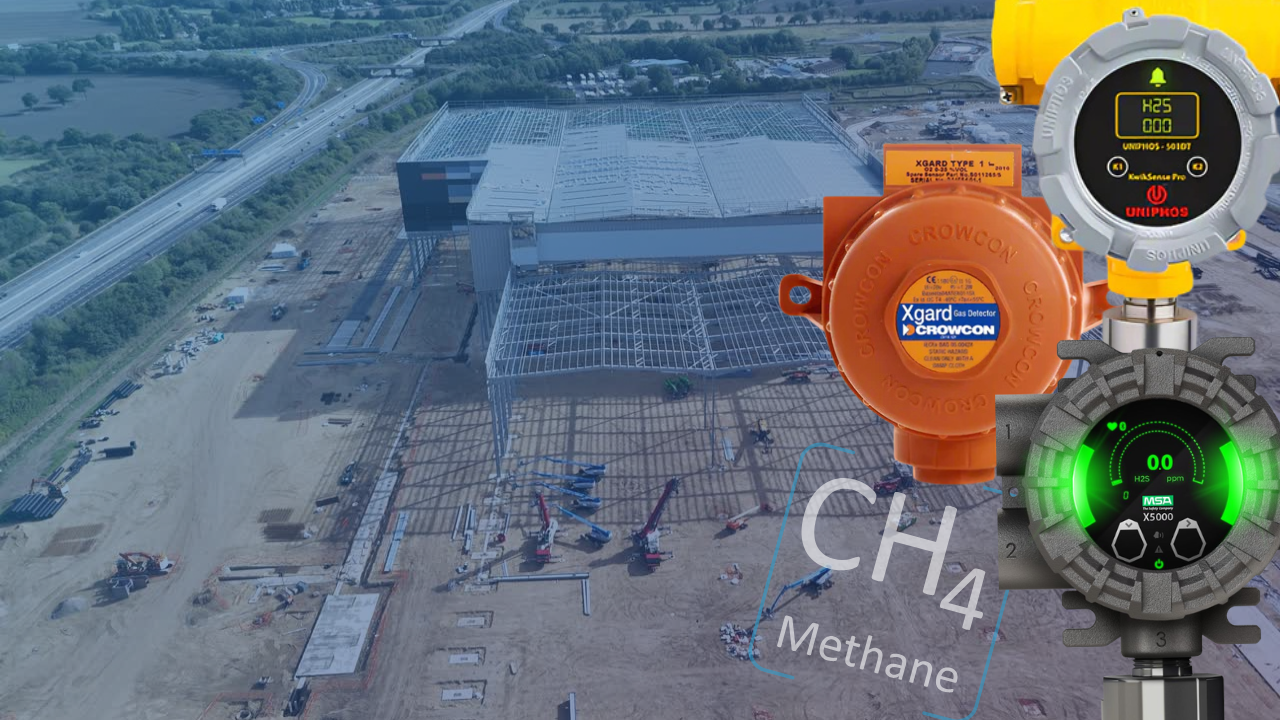
Brownfield redevelopment can bring former industrial, commercial, mining and waste sites back into productive use. However, completing construction does not necessarily mean that every ground gas risk has disappeared.
Historic land uses can leave sources of methane (CH₄) and other ground gases beneath a site, while changes to site conditions can influence potential gas migration pathways over time.
For developers, landowners and facilities teams, the important question is therefore not simply whether methane was present during site investigation, but whether the identified ground gas risks remain adequately controlled throughout the period for which monitoring or maintenance is required.
Where Does Methane Come From on Brownfield Sites?
Methane is a colourless, odourless and flammable gas. On previously developed land, potential sources can include:
- Historic landfill and waste deposits
- Buried organic material
- Former sewage or waste-treatment activities
- Made ground containing degradable material
- Former industrial processes
- Coal mining and other historic below-ground activities
Current Environment Agency Land Contamination Risk Management (LCRM) guidance identifies methane among the permanent gases that may arise naturally or from land contamination, waste deposits and other historic site activities.
The potential risks depend on the source, pathway and receptor. Methane can migrate through permeable ground, fractures, service routes and other pathways before accumulating within enclosed or poorly ventilated spaces.
Because methane is flammable, accumulation can create a fire or explosion risk. Ground gases can also contribute to oxygen-deficient atmospheres where displacement occurs.
What Does Current Guidance Say?
In England, the current National Planning Policy Framework (NPPF) requires sites proposed for development to be suitable for their intended use, taking account of ground conditions and risks arising from contamination.
Where a site is affected by contamination, responsibility for securing a safe development rests with the developer and/or landowner.
For historic land contamination, the Environment Agency's Land Contamination Risk Management (LCRM) framework provides the principal technical approach to identifying, assessing and managing risk.
This follows three broad stages:
- Risk assessment
- Options appraisal
- Remediation and verification
For ground gases, the assessment should consider potential sources, migration pathways and receptors, including risks of fire, explosion, asphyxiation and harm to buildings or other infrastructure.
Where remediation is required, LCRM also makes provision for long-term monitoring and maintenance where necessary.
Importantly, there is no universal requirement for every brownfield development to undertake methane monitoring for a fixed 30-year period. The appropriate duration and frequency should instead reflect the site-specific risk assessment, remediation strategy, verification requirements and any planning, regulatory or permit conditions applying to the site.
Why Can Monitoring Be Needed After Construction?
Ground gas conditions are not necessarily static.
Changes to groundwater levels, drainage, ground conditions, neighbouring construction or underground services can influence migration pathways. Buildings themselves can also change during their operational life through extensions, refurbishment or alterations to ventilation and services.
Gas protection measures therefore need to be considered as part of the site's wider risk-management strategy.
Current LCRM guidance recognises established industry standards including BS 8485 for protective measures against methane and carbon dioxide ground gases in new buildings, BS 8576 for ground gas investigations and CIRIA C735 for verification of gas protection systems.
Where the risk assessment or remediation strategy identifies a continuing requirement, post-development monitoring can provide evidence about whether ground gas conditions or the performance of control measures are changing.
Periodic Ground Gas Monitoring and Fixed Detection
Ground gas monitoring and fixed gas detection perform different functions and should not automatically be treated as alternatives.
Ground gas monitoring can be used to understand concentrations, pressure and changes within the ground and forms part of establishing and reviewing the conceptual site model.
For permitted landfill sites specifically, Environment Agency guidance requires monitoring programmes to be developed around the conceptual site model and risk assessment, illustrating the wider principle that monitoring should have a defined objective and respond to site-specific conditions.
Fixed methane detection, where justified by the risk assessment, can provide continuous atmospheric monitoring at selected locations within occupied or operational areas.
Potential locations might include:
- Basements
- Plant rooms
- Service ducts
- Utility areas
- Below-ground infrastructure
- Other enclosed areas identified by the risk assessment
A fixed system can provide an alarm if methane reaches predetermined levels and, depending on the system design, may interface with ventilation, building management or other safety systems.
The appropriate detector locations, alarm strategy and system response should always be determined by the application and risk assessment rather than applying a standard configuration to every brownfield development.
Workplace Responsibilities Should Also Be Considered
Where methane could create a fire or explosion risk within a workplace, additional requirements may apply.
The Dangerous Substances and Explosive Atmospheres Regulations 2002 (DSEAR) require employers to assess and control risks from dangerous substances that could cause fire or explosion.
This includes identifying dangerous substances, assessing where explosive atmospheres could occur, implementing appropriate controls and establishing procedures for foreseeable incidents.
Where below-ground chambers, service areas or other confined spaces are involved, the Confined Spaces Regulations 1997 and associated HSE guidance may also be relevant.
These workplace requirements sit alongside, rather than replace, the land contamination and planning framework.
Building a Long-Term Monitoring Strategy
The appropriate approach will vary considerably between sites.
A monitoring strategy should be informed by the conceptual site model and consider:
- Historic and current sources of ground gas
- Potential migration pathways
- Buildings and other receptors
- Previous monitoring results
- Installed gas protection measures
- Changes to the site or surrounding land
- Relevant planning or environmental permit conditions
- Maintenance and verification requirements
Where fixed methane detection forms part of the strategy, ongoing calibration, functional testing, maintenance and sensor replacement also need to be planned throughout the system's operational life.
Managing Methane Risk Beyond Development
Brownfield redevelopment can successfully manage historic contamination, but the risk-management process does not necessarily finish when construction is complete.
Current UK guidance supports a risk-based, site-specific approach. Where the conceptual site model identifies an ongoing methane risk, appropriate monitoring, maintenance and verification can help demonstrate that the measures put in place continue to provide the required protection.
Combining ground gas assessment with appropriate engineering controls and, where justified, fixed gas detection provides different layers of information and protection rather than relying on a single measure.
Fixed Gas Detection from Shawcity
Shawcity supports organisations across the UK and Ireland with the design, supply, installation, commissioning and maintenance of fixed gas detection systems.
For brownfield developments and existing sites where methane has been identified as a potential risk, our team can help assess the application and determine an appropriate detection approach as part of the wider site risk-management strategy.
To discuss methane or fixed gas detection for your site, contact the Shawcity team.




 01367 899553
 info@shawcity.co.uk