

Industrial flame detection is designed to identify a developing fire rapidly by detecting the characteristic radiation emitted by a flame.
Unlike smoke or heat detection, which responds to combustion products or rising temperature, optical flame detectors identify the radiation emitted by a flame. This makes them particularly useful in high-consequence environments where rapid detection matters, including process plants, fuel handling areas and offshore installations.
Understanding how different flame detection technologies work is important because no single detector is suitable for every fuel, environment or application.
What Does a Flame Detector Detect?
An optical flame detector recognises characteristic electromagnetic radiation produced during combustion rather than smoke particles, temperature changes or the presence of a particular gas.
Flames emit radiation across different wavelengths, including ultraviolet (UV) and infrared (IR). Hydrocarbon fires produce a particularly strong IR signature associated with carbon dioxide (CO₂) generated during combustion, with a characteristic emission around 4.3–4.35 microns.
A detector's sensors monitor selected parts of this spectrum. Its electronics then analyse the signal, filter background radiation and determine whether the pattern is consistent with a fire.
Different fuels produce different spectral characteristics. Hydrocarbon and hydrogen flames, for example, do not present identical signatures. Detector selection therefore needs to consider the fuel or materials involved rather than treating all fires as equivalent.
The Main Flame Detection Technologies
UV Detection
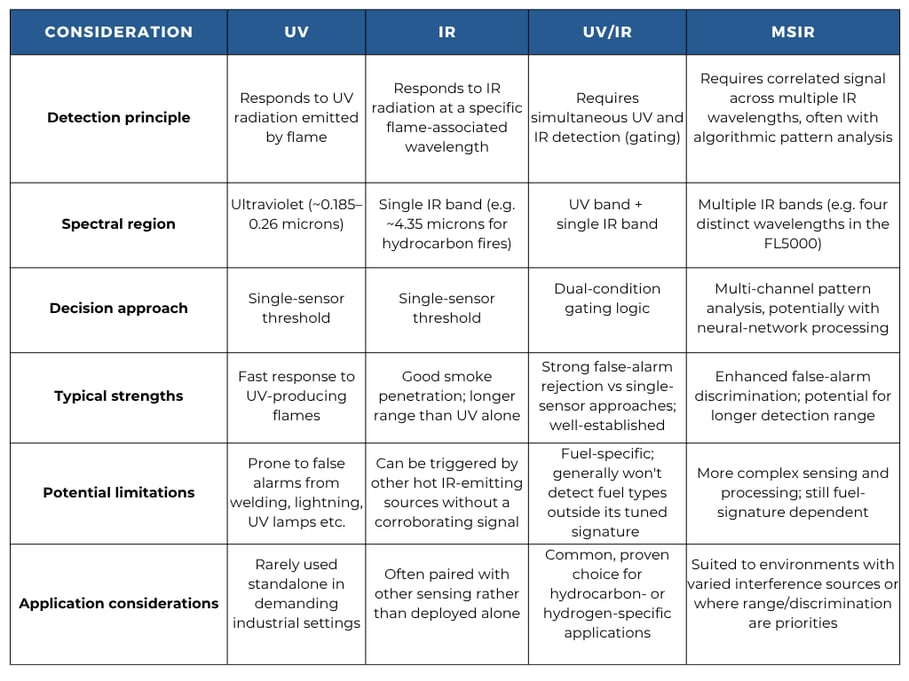
UV detectors respond to ultraviolet radiation produced by a flame. They can react quickly, but other sources including arc welding, lightning and electrical discharge can also generate UV radiation.
This potential for interference means UV sensing is often combined with another technology in demanding industrial applications.
IR Detection
IR flame detectors monitor infrared radiation at wavelengths associated with combustion. For hydrocarbon fires, this commonly includes the CO₂ emission region around 4.3–4.35 microns.
IR detection can provide good detection range and may be less affected by some obscurants than UV detection, but hot objects and processes can also produce infrared radiation. Using a single IR wavelength therefore provides less information for distinguishing a genuine flame from an interference source.
UV/IR Detection
UV/IR detectors combine ultraviolet and infrared sensing.
The detector evaluates the UV and IR signals together, using signal-processing logic to determine whether the radiation is consistent with a flame. This improves false-alarm immunity compared with relying on a single spectral region.
The technology is well established in industrial flame detection, but detectors are generally configured around particular fuel characteristics. A detector intended for hydrocarbon fires should not automatically be assumed suitable for hydrogen or another fuel.
Multi-Spectrum Infrared (MSIR)
MSIR uses several infrared wavelengths rather than relying on a single IR channel or a UV/IR pair.
The detector compares the radiation pattern across those channels to distinguish a fire from potential interference. More advanced systems may also analyse characteristics such as flame flicker using signal-processing algorithms.
This additional information can improve false-alarm discrimination in challenging environments, while some MSIR detector designs also offer extended detection ranges. Performance still depends on the fuel, application and individual detector design.
UV/IR vs MSIR
The distinction between UV/IR and MSIR is less about one technology being universally better and more about how each decides whether a fire is present.
UV/IR evaluates ultraviolet and infrared radiation together. It is a proven approach and remains suitable for many hydrocarbon and other fuel-specific applications when the detector is correctly selected.
MSIR evaluates patterns across several infrared wavelengths, providing more information with which to distinguish a flame from background radiation and potential interference.
The appropriate technology depends on factors including:
- Fuel or material being protected
- Required detection distance
- Potential false-alarm sources
- Environmental conditions
- Field of view and site geometry
- Required response time
Where a site contains significant radiation interference, the additional discrimination offered by MSIR may be valuable. Where longer-range detection is required, the specified detection performance of the individual detector should also be assessed.
Neither approach should be selected on technology alone. The detector needs to be suitable for the specific fire hazard and conditions in which it will operate.
What Affects Flame Detector Performance?
Published detection ranges and response times are established under defined test conditions. Actual performance on site depends on the application.
Fuel and fire characteristics
Detectors are tested against specific fuels and fire sizes because different materials produce different spectral signatures and combustion characteristics.
A detector's stated capability should therefore be considered in relation to the credible fire scenarios identified by the site's risk assessment.
Distance and field of view
Optical flame detectors require a clear view of the area being protected.
Detection capability is influenced by both fire size and distance. Every detector also has a defined field of view (FOV), so positioning needs to account for the areas requiring coverage rather than simply installing detectors at convenient locations.
Obstructions
Equipment, structural steelwork, vessels, pipework and other physical obstructions can block the detector's line of sight.
Detector layout therefore needs to reflect the actual geometry of the installation.
Environmental conditions
Temperature, weather exposure, humidity, dust and contamination can influence detector selection, housing requirements and maintenance.
Contamination of the optical window can reduce sensitivity, making inspection and cleaning important considerations for ongoing system performance. Optical self-check functions can also help identify conditions affecting the detector's optical path.
Interference sources
Potential sources of radiation can include welding, flares, hot equipment, sunlight and some lighting systems.
Which sources matter depends on the detector technology and the environment. Understanding these influences before selecting a detector is an important part of reducing unwanted alarms.
Selecting the Right Flame Detection Technology
Flame detector selection should begin with the application rather than a comparison of product specifications.
Key questions include:
- What fuels or combustible materials are present?
- What fire scenarios are credible?
- How far must the detector be able to detect the required fire?
- What areas need to fall within its field of view?
- Are there physical obstructions?
- What potential interference sources are present?
- What environmental conditions will the detector experience?
- What response time is required?
- Are there relevant site, regulatory, certification or insurance requirements?
Once these factors are understood, detection range, technology and individual product specifications can be compared meaningfully.
MSA Flame Detection
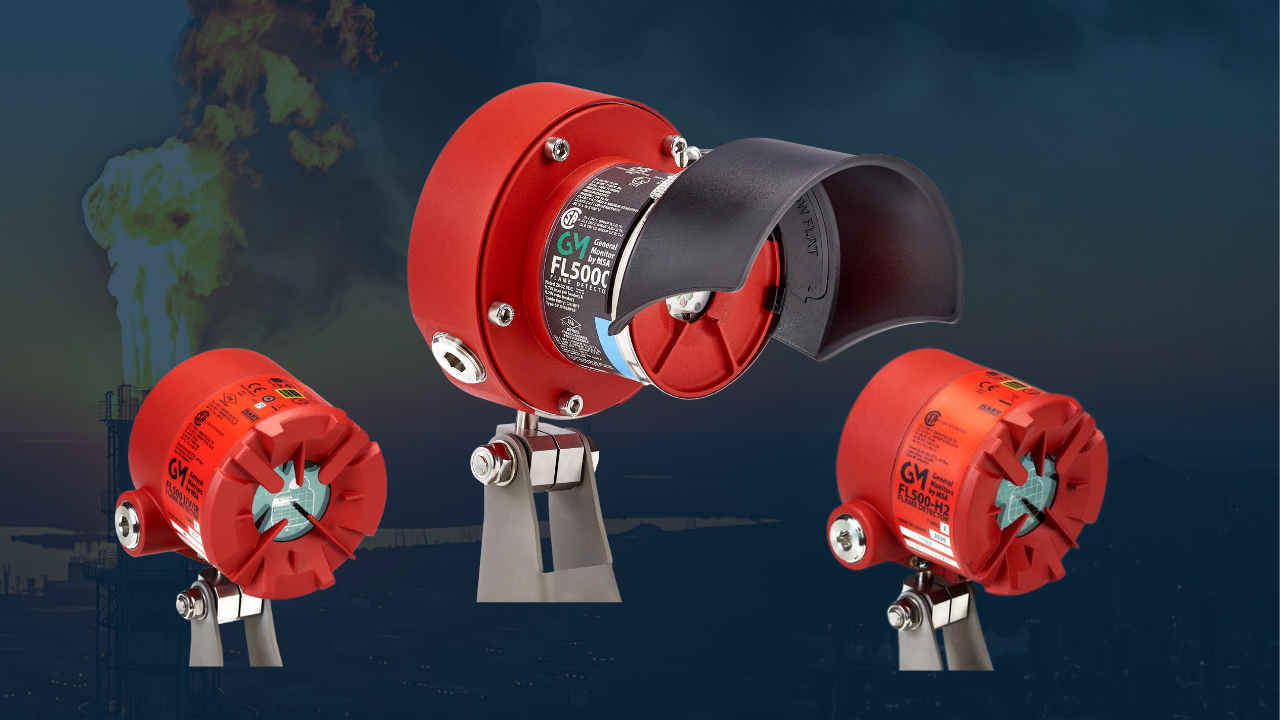
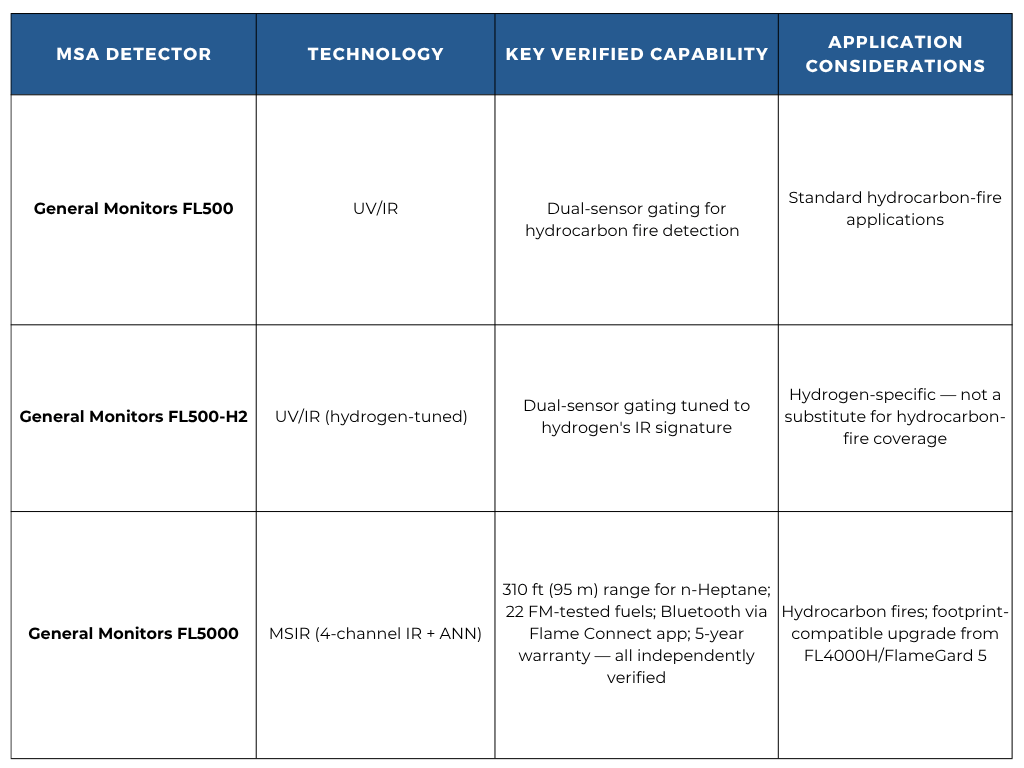
MSA's General Monitors range provides examples of both UV/IR and MSIR technologies.
General Monitors FL500 uses multi-spectrum infrared technology, analysing multiple IR wavelengths with advanced flame-detection algorithms. It is designed for hydrocarbon fire detection where detection performance and false-alarm discrimination are important considerations.
General Monitors FL500-H2 applies UV/IR technology specifically to hydrogen flame detection. Its fuel-specific design illustrates why a detector intended for one type of fire should not automatically be assumed suitable for another.
General Monitors FL5000 uses multi-spectrum infrared technology, with four IR channels and advanced signal processing. It is designed for hydrocarbon fire detection where range and false-alarm discrimination are important considerations.
The appropriate detector still depends on the specific fire hazard, site conditions, required coverage and wider fire and gas detection strategy.
Where Shawcity Fits In
Specifying flame detection involves more than selecting a detector from a datasheet. Fuel type, detection distance, field of view, interference sources, environmental conditions and site geometry all influence system design.
Shawcity supports organisations with the specification, supply, installation, commissioning, service and maintenance of fixed gas and flame detection systems, working with manufacturer partners including MSA.
Whether you are reviewing an existing system, comparing UV/IR and MSIR technologies or planning a new installation, our technical team can help assess the application before recommending an appropriate detection approach.
Speak to Shawcity about flame detection.
%20(3).png)


 01367 899553
 info@shawcity.co.uk